Whether you just have a small urban backyard, or a 100 acre farm, I’m excited to get to work with you to design your site into an abundant food producing system that will last generations! We need more people like you!
Credentials…
Permaculture design incorporates many vast fields of expertise; animal husbandry, fruit tree pruning, tool use and care, natural building, soil biology, earthworks and more. I have to preface that I’m still earning my wings when it comes to this wealth of information; I know a lot about some things, and not a lot about other things. But I’ll give you what I got, which is usually more than most people can handle. My hope is that the educational process goes both directions and we can both fill in one another’s gaps in understanding the big picture we’re designing together.
In addition to hours and hours of textbook and online research and spending time with farmers, foragers and fellow permies, I’ve graduated from the following courses;
- Edible Ecosystem Design Course (Nov 2012)- Dave Jacke
- Permaculture Design Certificate Course (Oct 2013) – Geoff Lawton
- Introduction to Urban Permaculture Design (Aug 2012) – Little Artshram
- The Natural Cottage Project (July 2012) – Strawbale Studio
- Advanced Permaculture Teacher Training (March 2017) – Peter Bane
How it Works…
Everyone has their own unique work and planning methods, so I can adapt my consultation to fit your style. Usually we begin by having you fill out an in depth questionnaire so that I can get as much information as possible about your vision, needs, goals, and the existing site conditions. After I’ve had time to review this, then we can set up an initial site visit/meet and greet, or phone meet up. From here we’ll begin doing a more in depth analysis and assessment of the various features of your site; climate, topography, existing species, water movement etc.
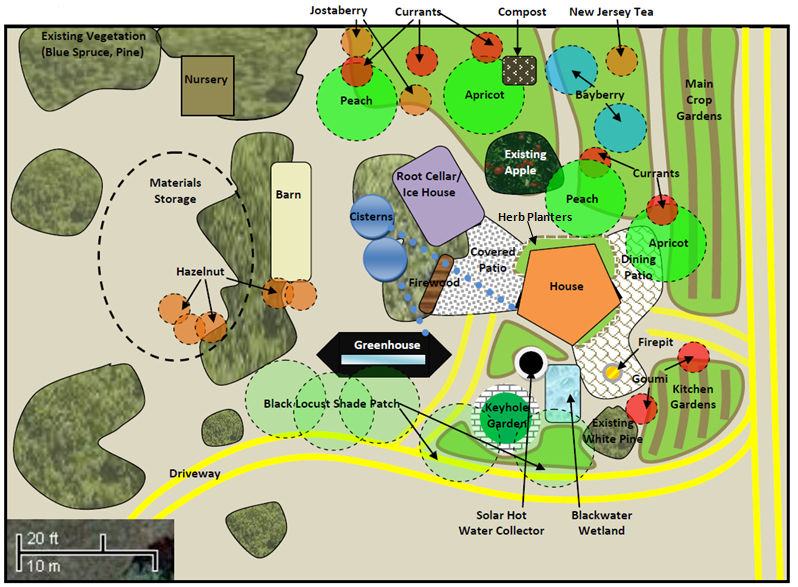
Once we’ve gathered all this information, then we’ll move into the design phase where we begin to put the pen to map and start drawing up possible site designs. Once you’re completely happy with the design, then we’ll begin fleshing out the details; how many plants, costs, materials, width of paths, yards of compost etc. Then comes the fun part of gathering all your friends and DOING IT! Adapting as needed to changing circumstances. After it’s all said and done, then we’ll step back and see what worked, what didn’t, and go back to the start again on our design cycle.

The Design Process
Permaculture design is an ongoing, ever-evolving thing. It’s a years-long process. So in addition to being a designer, I also act as an educator to empower you do continue the design process yourself, and learn to work with the new systems we install.
This is a four-dimensional design process. We are designing on a number of different layers; physical – plant spacing, behavioral – management patterns, conceptual – goals values, temporal – development through time (100+ years).
What we’ve learned is that in a web (which is what we’re creating; a web of relationships; plant to human, soil to sun, etc) that there is no start and end. It’s not like writing a book where you start at the beginning and go till the end. It’s a cycle; you start out with a very blurry picture of what we’re designing together (in partnership with one another and the landscape) go over the whole process with broad strokes, then start at the beginning again and start refining and clarifying, seeking out new deeper insights, new connections, possibilities etc.
Hope all that makes some sense and isn’t too woo-woo for you. For more of an outline look, you can see below.
The big picture looks like this;
1. Goals Articulation – these are the rudder to guide the design process.
- Questionnaire
- 3 sentence Mission Statement (“Why” are you doing this, Underlying Values)
- List of Specific Goals (“What” are you doing)
2. Site Analysis and Assessment – What’s there? So What? Look for patterns, Observation and Interpretation, understanding the relationships on site, start making connections…
Use the Scale of Permanence (below) – The features that are least changeable (most permanent) should be assessed first.
- Climate
- Landform (Slope, Contour etc)
- Water Supply
- Legal Issues
- Roads/Access
- Existing Vegetation and Wildlife
- Existing Infrastructure (buildings, plumbing etc)
- Zones of Use
- Fencing
- Soil (Fertility and Management)
- Aesthetics
3. Design Concept – “How” you’re going to accomplish your stated goals, to fulfill your values.
Four Realms of Design:
- Infrastructure – ex; Greenhouse, drainage, paths etc.
- Architecture – ex; Garden patches, layers, density etc.
- Social Structure – ex; species and relationships, niches, polycultures, guilds
- Succession – ex; site prep, implementation, management, succession (designing in time, not just space)
Four Stages of Design: – From large patterns/big picture down to details
- Design Concept – overall vision, main organizing idea, how to achieve goals/mission, essence of the pattern, thumbnail design
- Schematic – Rough location and relationships, bubble diagrams, direction of design (big markers on map) Brainstorm
- Detailed Design – Fine pen/pencil work, filtering ideas, exact sizes/locations, width of paths, size of house, grading/landform etc
- Patch Design – Zoomed in detail on each patch, How many posts, how much $ per plant, Management plans, fine details, # of plants, spacing etc.
4. Implementation – Gather the materials, bring together your friends and family and DO IT! You’ve planned the work, now work the plan! Adapting as needed, as conditions change.
5. Evaluation – Were we successful? What worked? What didn’t? Go back to step 1 and continue the cycle indefinitely, modifying either you’re initial expectations, or your follow up procedures.
If you have any more questions about the process, fees, or anything at all just let me know. Once I get the questionnaire back, then we can schedule a time to meet on site, or talk on the phone and get to know one another. 🙂
Thanks again! I’m looking forward to helping you make your vision a reality!
-Levi Meeuwenberg, Certified Permaculture Designer